
Affordable Care Act’s First Step out the Door
- Jan 13, 2017
- 3 min read
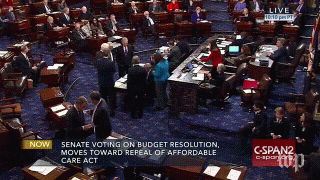
During a late night – and early morning – “vote-a-rama,” the Senate passed a budget resolution on the Affordable Care Act (ACA). While most Americans were asleep at 1:30am this Thursday, a 51-48 vote was cast to repeal parts of Obamacare, reported NPR’s Danielle Kurtzleben and Ailsa Chang. During this session, senators voted on an unlimited number of amendments to pass to the House for budget reconciliation. The Republicans found this convenient because this process is exempt from filibustering, requiring a simple majority vote. There is one main limitation: Senate can only address the budget portion of bills. For the Affordable Care Act, that deals with taxes imposed on people or funds spent by the government.
Democrats did not go out without a fight. After physically protesting on the senate floor earlier this week, Democratic senators rallied one last message. Sen. Tammy Duckworth, D-Ill, said, “For all those with pre-existing conditions, I stand on prosthetic legs to vote no!"
Despite the hasty uproars, this initial action will not repeal the part of the law that prohibit companies from refusing coverage to pre-existing condition patients. Additionally, young adults –for example, a broke college student like myself –can stay on parents’ insurance plans until age 26. At least, not until the House passes the budget and drafts a repeal bill to vote on. Consequently, the Senate will debate on the repeal and cast a vote for Trump to sign into law; I anticipate more fiery words and amendments. In the event, the House and Senate do not compose a replacement plan quickly, it will be the health of the people that hangs in the balance. The repeal will redraft the ACA’s tax requirement for universal healthcare, funding provided for private coverage subsidies, and Medicaid funds that millions of people depend on (also assisting the Republican agenda to defund Planned Parenthood).
Fortunately, Republicans and Democrats can agree on some basic liberties of the people according to the following points, reported by CNN’s Tami Luhby:
Pre-existing condition patients should not be denied healthcare. Many Republican replacement plans agree with the ACA that this is a necessary policy, however you would have to be on an insurance policy continuously. Meaning if you do not have insurance now or have a wide gap in your recent coverage history, you may not be protected under that law.
Health premiums need to be lowered. Replacement plans include a tax credit based on age to cover premiums, along with the promotion of health savings accounts. This contrasts with Obamacare which uses tax credits in advance (i.e. subsidies) to cut premium costs based on income.
Employer insurance plans are costing a fortune. Republicans are including a method to prevent employers from offering costly coverage by adding a deductible cap for premiums, with the intention to use a possible tax bill as means of encouraging affordable plan offers. The ACA’s method, planned to enact in 2020, would tax expensive employer plans with a 40% levy.
While the methods are different, these concepts are a bipartisan headache. On the other hand, replacement plans will likely not include a universal coverage mandate or the requirement of maternity care, mental health coverage, prescriptions, vaccines, etc. to be provided by all insurance plans. These directives violate the GOP ideology of a free market and limited government control.
We, the people, will know our fate in as little as two months or by this time next year. Republicans rest assure plans were already drafted and hope to be finalized sooner rather than later. If the Democrats allow them to make their bed, the time frame of a few months sounds promising. But until then, enjoy your Affordable Care Act benefits while they last and have faith the replacement plan will accommodate our evolving society.


Comments